
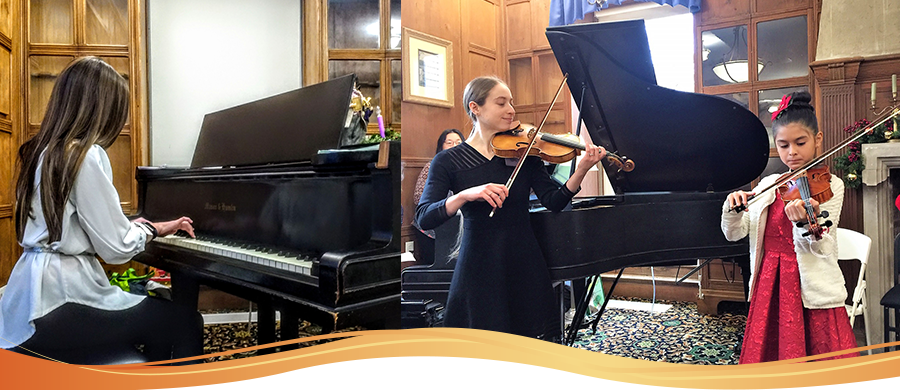
Violinist age 10 plays Schubert Sonatina in D, third movement
Viennese composer Franz Schubert lived only from 1797 to 1828, but he managed to compose a vast amount of music in that short time – over 600 songs, seven symphonies, a large amount of piano and chamber music (music for a small group of players), operas, and church music.
The 12th of 14 children, his musical gifts were obvious early on. He started piano lessons with his brother at 5, and violin lessons with his father at 8, but he soon outgrew their ability to teach him. After finishing his training he became a schoolteacher and also gave private music lessons, earning just enough money for his basic needs, including clothing, manuscript paper, pens, and ink, but with little to no money left over for luxuries. His life was never easy, but he did have a small circle of admirers in Vienna. Today, though, Schubert is considered one of the greatest composers of Western classical music, and his heartfelt music continues to be popular.
A sonata is a composition for one or two (occasionally three) instruments, frequently including a piano; and a sonatina literally means a “little sonata” – something shorter and easier. The piano is an equal partner here, with each performer taking turns to have the tune or the accompaniment. This lively movement in 6/8 time is based on a gigue, or jig.
Pianist age 11 plays “Just Struttin’ Along” by Martha Mier
Martha Mier is an American composer and piano teacher who was born in 1936 and lives in Lake City, FL. She has written more than 60 books of catchy solo and duet pieces for piano students from elementary to advanced level.
Many of her pieces, including this one, are written in a jazz style (remember Tick Tock the Jazz Clock?). Her music is really fun to play!
Violinist age 9 plays “Allegretto” by Suzuki
Musical pieces usually have a clear structure somewhat like a Lego building, and when you can begin to hear that, putting them together from their parts is much easier! This one features the Three Bears, and is built in sections like this:
A1
A2 (almost the same, but a different ending)
B (completely different)
A2
Just as in the singalongs on Day 4 and Day 8, you can hear how the same music has (mostly) the same words. We’ve also underlined the A1 and A2 endings, so you can hear the difference between them.
[A1] In a place far away on a hot summer’s day, the three bears’ cabin stood on the edge of a wood.
[A2] In that place far away on that hot summer’s day,the three bears went away for a walk.
[B] First the big Papa Bear, then the kind Mama Bear; far away, with his chair, came the small Baby Bear…..
[A2] In a place far away on a hot summer’s day, the three bears went away for a walk.
Page 10 of 15


