
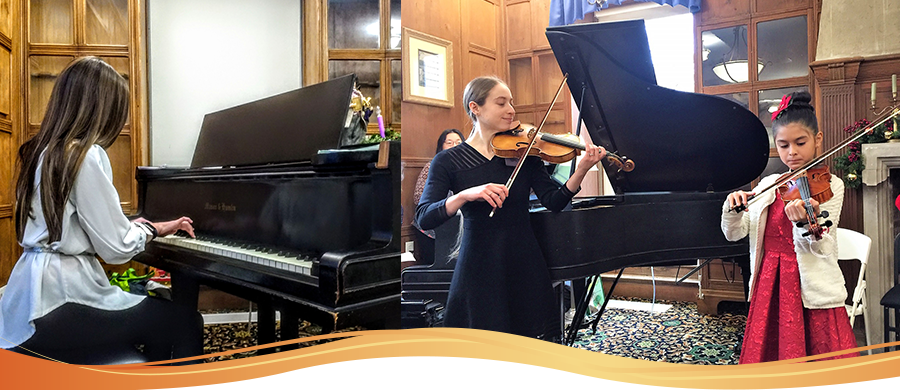
Welcome to our Music for the Community page! Since we can't take our music out to local nursing homes and libraries at the moment, we're inviting you in to enjoy it here instead. Each day you'll find a new student performance on this page, along with some info about the composer or instrument - and sometimes words too so you can sing along.
If you're interested in a particular category, you can sort performances by student age, instrument, singalong music, composer and so on - click on the orange tags under the text. We hope you and your family will enjoy watching our students share their music!
To have each week's videos and accompanying info sent to your inbox*, please subscribe via the orange button.
*Videos are delivered twice weekly; you can unsubscribe at any time, and we will never share or sell your info.
Born in Prussia (now part of Germany), Edward Mollenhauer (1827–1914) achieved success in America as a violin soloist and teacher. His best-known pieces for young violinists are “The Infant Paganini” and “The Boy Paganini”, written in homage to the legendary Paganini himself - see below - and including some of Paganini’s own special violin techniques. Of these, listen out for:
harmonics (1:40 - 1:50)
left hand pizzicato (plucking) mixed with bowed notes (2:54 - 3:11)
chords on all four strings (3:27, 3:49)
simple octaves (4:49)
Niccolo Paganini (1782-1840) himself was a household name in his time, touring Europe to rave reviews and swooning audiences. He was a great showman as well as artist, and would wow his audiences by playing so furiously that he would break all his strings except one, then finishing the piece with flair on the one remaining string (of course, he had perpared this on purpose!).
Paganini composed all the music that he played at his own concerts. In the process he wrote some of the most fiendishly difficult technical works for violin, including his famous set of 24 Caprices - which still offer the highest of technical challenges for 21st century violinists.
Pianist age 6 plays "This is not Jingle Bells" and "Row, Row, Row your Boat"
Well, it does sound at first like it’s going to be Jingle Bells - but then it changes its mind! Can you identify the other tune? And does it come in the right order, or….?
That first one could be confusing to try and sing along with, but Row, Row, Row Your Boat is pretty straightforward, and you can feel the lilting triple time in “Mer-ri-ly, mer-ri-ly…”, as if you’re on the water.
Cellist age 16 plays Bourrées I & II from Bach Solo Suite #3 in C
More old-fashioned dance music today, but unlike a Minuet, a Bourrée (pronounced "boo-ray") is in duple time (ONE two, ONE two) – similar to a Gavotte. Still, like our Minuet and Trio on Day 36, this set of two Bourrées is again made on an overall A B A pattern.
Why is this such a common musical form? It's because it's satisfying: after you hear the A, then the B in contrast, returning to the A gives a feeling of “coming home”, and also provides a simple sense of symmetry. That’s true in very small pieces like Twinkle, in dance sets like this one – and even often in big symphonies by composers such as Beethoven. Teaching students to hear and understand this in the music they're playing helps them to appreciate all music more deeply.
The music of Bach’s six unaccompanied cello/viola suites is some of the most beautiful there is to play, and gives musicians both a musical and technical workout. It’s always exciting for us as teachers when student reach the milestone of being ready to discover them!
Violinist age 8 plays "Red Parrot, Green Parrot" by Edwards Huws Jones
This is one of our favorite easy pieces for violin – the parrot squawks are always a big hit, in lessons and in recital!
It’s also great for singing along. It has a simple A, B1, A, B2, A pattern – think “Jingle Bells” with chorus, verse, chorus, verse, chorus. The only difference between the two B sections is that in the first one, the violinist has the tune and the pianist provides the parrot squawks; while the second time around they switch. Of course, that’s the part that everyone’s waiting for!
A) Red -- parrot, green -- parrot,
Perch -- on a tree,
Red -- parrot, green -- parrot,
Fly -- ing -- free!
B1) Red -- parrot squawk: SQUAWK!!
Green -- parrot squawk: SQUAWK!!
Some -- parrots talk -- but --
These ones only squawk.
Then back to A, B2, A – same words as above.
You need only 2 fingers on one string, plus the other open strings, to play this song. But you're learning several musical skills along with these easy notes – including changing rhythms, “dynamics” (switching from loud to soft, both suddenly and gradually), and listening to the other player while you keep count, so you can jump in with your squawks at exactly the right time.