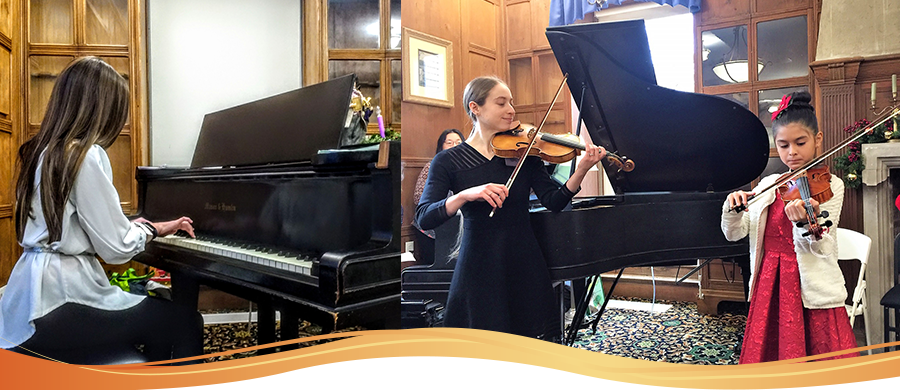
Welcome to our Music for the Community page! Since we can't take our music out to local nursing homes and libraries at the moment, we're inviting you in to enjoy it here instead. Each day you'll find a new student performance on this page, along with some info about the composer or instrument - and sometimes words too so you can sing along.
If you're interested in a particular category, you can sort performances by student age, instrument, singalong music, composer and so on - click on the orange tags under the text. We hope you and your family will enjoy watching our students share their music!
To have each week's videos and accompanying info sent to your inbox*, please subscribe via the orange button.
*Videos are delivered twice weekly; you can unsubscribe at any time, and we will never share or sell your info.
Cellist age 9 plays Harry Potter: Hedwig’s Theme and Fireworks
“Hedwig’s Theme” (by John Williams) is the dominant theme used in all of the Harry Potter films. In spite of its title, it doesn't always specifically represent Hedwig, Harry’s owl, but rather the wider idea of magic and the Wizarding World.
“Fireworks” (by Nicholas Hooper) is first heard in “Harry Potter and the Order of the Phoenix”, and is a musical picture of the antics of the Weasley twins, Fred and George, who frequently cause havoc with their mischievous magical experiments.
This young performer not only found and prepared this music herself, then persuaded her talented Mom to accompany her - she gave us an extra bonus by performing in full Harry Potter costume!
Violinist age 8 plays "Lollipop Man" by Katherine and Hugh Colledge
Husband and wife team Kathy (b.1952) and Hugh (b.1945) Colledge both worked as instrumental music teachers in East London before moving to Norfolk in 1995. Their compositions and arrangements are a joint effort, with Kathy being the string instrument composer and Hugh writing the piano accompaniments.
This student learned "Lollipop Man" as part of her preparation for the Royal Conservatory external evaluation program. We’ve offered this program since 2014 for students who want to challenge themselves; we’ve seen enormous growth those taking part, and have been proud to see several of them honored with both Evaluation Center and State level “Certificates of Excellence” for the highest mark at their level.
Violinist age 16 plays Mozart's Violin Concerto #3 in G major, 1st movement
We hope you’ve enjoyed a peek behind the scenes of students’ musical and technical development in this week’s entries. Our aim as teachers is to help students enjoy and celebrate all these stages on a well-planned journey, giving them appropriate music for their age and skill level along the way. But we do this also with - from their very first lesson - the long-term goal of giving them full ownership of their own musical and expressive voice.
So to finish our week, here’s a video to show where this has all been heading: a performance by a student who is well past the basic and intermediate stages, and is now ready and equipped to explore professional-level repertoire in the form of one of Mozart’s sparkling violin concertos.
While the video was not taken from the best angle, we’re pretty sure you’ll enjoy this young man’s sensitive and expressive playing, and how he's now able to put his technical skills at the service of Mozart's beautiful and timeless music.
Violist age 15 plays Seitz Concerto in D, first movement
Friedrich Seitz (1848 - 1918) was a German violinist and composer, conductor, concertmaster (first chair in an orchestra), and teacher. He wrote five “Pupil’s Concertos”, as he called them, as a stepping-stone between easier short pieces and the longer, more challenging concertos of Vivaldi, Bach and Mozart. This student is well on the way to completing that transition.
The viola is bigger and lower in pitch than the violin – see also these performances. It loses the highest string (E) on the violin in exchange for a lower one (the C below middle C) at the other end; this, and the greater volume of air inside it, makes for a darker, richer, velvety sound. But the fingering system is exactly the same as on violin, so anything written for violin can be very easily adapted for viola, as has been done here.