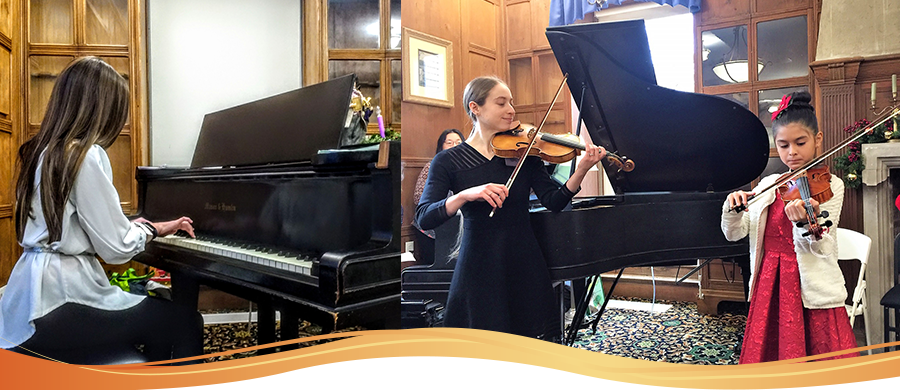
Welcome to our Music for the Community page! Since we can't take our music out to local nursing homes and libraries at the moment, we're inviting you in to enjoy it here instead. Each day you'll find a new student performance on this page, along with some info about the composer or instrument - and sometimes words too so you can sing along.
If you're interested in a particular category, you can sort performances by student age, instrument, singalong music, composer and so on - click on the orange tags under the text. We hope you and your family will enjoy watching our students share their music!
To have each week's videos and accompanying info sent to your inbox*, please subscribe via the orange button.
*Videos are delivered twice weekly; you can unsubscribe at any time, and we will never share or sell your info.
Violinist age 14 plays Theme from “Schindler’s List”
Steven Spielberg’s movie “Schindler’s List”, about the German manufacturer Oskar Schindler who saved more than 1000 Jews from the Holocaust by employing them in his factories, won 7 Oscars including Best Picture for Spielberg and Best Score (Music) for composer John Williams.
We feature its theme in homage to today’s observance of Holocaust Memorial Day, and in solidarity with victims of oppression everywhere.
Violinist age 4 plays Twinkle Variation A, Massachusetts Music
This is the first piece that the young musicians in our Suzuki Program learn. The rhythm “Massachusetts Music” is an easy one for beginners, as it uses very short bow strokes – but it’s also something that will reappear many times in much bigger pieces, including professional ones.
This little student started in our Wayland Recreation “Small Group Intro to Violin” class over the summer. Five months later, and she was ready to share her music with an audience. She gets extra brownie points for stopping to “build fingers” carefully when she moves to a new string. Skills built solidly in small steps like this will lead to ease and confidence at all levels of playing.
More dance music today – this time from South America. The tango combines musical elements from African, Native American and European cultures, and started in the 1880s among communities alongside the Rio de la Plata (Silver River), which is the natural border between the countries of Argentina and Uruguay. It was originally a dance for the common people, popular in dockside cafes and nightclubs, but eventually spread to Europe and North America too. Listen for the “Pa-PAH—pa pum-pum” rhythm that happens throughout the piece.
Violist age 16 plays “Courante” from Bach Suite #3 for Viola/Cello
A viola is more than just a “big violin”. That extra size gives it a deeper, darker sound. Bigger things vibrate more slowly - try filling a smaller glass and a bigger glass with water, and tapping them each with a fork, and you’ll hear that idea at its most basic.
The viola has the same tuning as the cello, except an octave higher (meaning the viola’s strings vibrate exactly twice as fast as a cello’s) - so they can share some of the same music, including Bach’s solo suites. “Suite” means a collection of pieces which go together, and Bach’s suites are collections of 18th century dance music. “Courante” literally means “running”, and you can hear how this piece just keeps going and going – try running around to it!
If you like the sound of the viola, it’s a great instrument to learn to play – there are never enough viola players, and you will get lots of invitations to play with others!